


Bio
Inspired by Carl Jung’s concept of meaningful coincidence, Synchronicity exists beyond genre boundaries. Their music fuses instrumental metal, progressive textures, and alternative rock atmospheres into sonic journeys that require no words. With no vocalist to guide interpretation, the listener becomes the narrator—each note a spark for personal introspection, connection, and emotion.
Formed by Antonio Masis (bass), Rodrigo Chaverri (drums), and Rafael Castro (guitar)—seasoned musicians with extensive careers touring across Europe, Asia, and the Americas—Synchronicity came to life through a powerful creative alignment. Though the project is new, its members have long commanded international stages, having performed at iconic festivals like Wacken Open Air (Germany), Bloodstock Open Air (UK), and Barroselas Metalfest (Portugal). Through their involvement in other prominent bands, they’ve also shared the stage with legends such as Metallica, Black Sabbath, Megadeth, Judas Priest, Slayer, Red Hot Chili Peppers and Whitesnake in Costa Rica—experiences that honed their craft and fueled the artistic vision behind Synchronicity.
Their upcoming 2025 releases—Synchronicity, Shadow Self, and Meaningful Coincidence—mark the beginning of this new chapter. Each track is a deliberate expression, echoing their belief that music can connect across borders, languages, and expectations.
Synchronicity is not just a name—it’s a declaration. A sound born at the crossroads of art, time, and destiny.
The Band
.jpg)
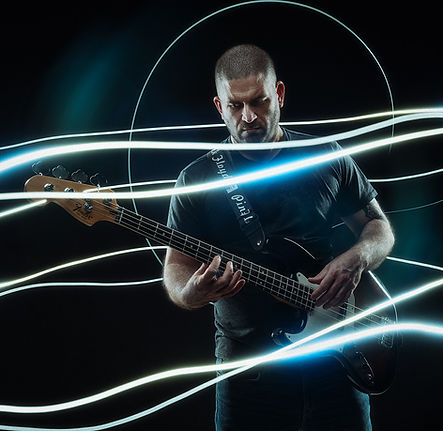
Antonio Masís


As a child, Antonio Masís would sit for hours by the stereo, rewinding bass lines to figure out what made them pulse, breathe, move. He didn’t know it then, but that curiosity would grow into a lifelong obsession with the low end—not just as an instrument, but as an emotional backbone.
Antonio never settled for a single sound. His journey has taken him through the angular world of progressive rock, the intensity of groove metal, the intricacy of jazz fusion, and even the structure and nuance of classical music. He learned to blend these influences not to impress, but to express. For him, music is language, and the bass is his most fluent voice.
Through projects like Pneuma and Sinistra, he’s carved out a path built on both technical skill and emotional weight. His 2024 release Human Nature wasn’t just a progressive rock album—it was the culmination of years of refinement, and a mirror of everything he had to say without saying it directly.
He’s collaborated with orchestras, shaped complex metal arrangements, and built songs that are as layered as they are honest. His influences—Sean Malone, Victor Wooten, Flea, Paul McCartney, Billy Sheehan, Les Claypool—each left fingerprints on his playing, but none defined him. That voice, he built himself.
With Synchronicity, Antonio stepped into a new kind of challenge: pure instrumental expression, where every note matters and every silence carries weight. Composing alongside longtime friends Rod and Rafa gave him space to push, to listen deeply, and to find new forms of clarity.
Offstage, Antonio doesn’t chase speed or complexity for its own sake. What drives him is the possibility—that maybe one of these songs, one of these grooves, might leave something behind.
“The great thing about writing music is leaving a piece of you in every song. No matter how successful you are, the songs you help create are a unique product done by you and your bandmates. That’s what I love about music and art in general.”
.jpg)
Rodrigo Chaverri
Rod Chaverri’s first drum kit was a set of boxes. Whatever he could hit, he hit. Long before he learned names like “hi-hat” or “ride,” rhythm was already part of how he processed the world. The real turning point came when he watched Tommy Lee spinning in a metal cage in the video for Wild Side. It wasn’t just the spectacle—it was the energy. The urgency. The freedom.
From that moment on, drums became something bigger than an instrument. Rod started out self-taught, playing in a church choir, copying beats by ear, making sense of it all with his hands. Later, he deepened his craft through private lessons, music school, instructional videos, magazine articles—anything he could get his hands on. And hours. Always hours.
He moved through a wide landscape of Costa Rican bands—Sight of Emptiness, Keep the Gap, Inersia, Despot, Abalone, Extrasensorial, Crayón, and more. With each one, his playing adapted, expanded, got heavier, groovier, faster, more precise. For Rod, drumming was never about locking into one genre. It was about building a voice, one beat at a time.
Synchronicity gave him something he hadn’t explored before: silence between the notes. The kind of musical space that only instrumental music allows. As drummer and co-composer, he helps shape the spine of each song—its tempo, its structure, its dynamic tension. His influences range from the raw power of metal to the intricate frameworks of progressive and groove-heavy rhythms. But he’s not trying to impress anyone. He’s trying to say something—without saying anything.
Offstage, Rod lives a life of movement. He writes drum music. He experiments. He prepares. Before every show, he warms up not just his muscles but his mind. There’s a kind of discipline in repetition. A clarity.
“Instrumental music has the power to say everything without saying a word. If you connect with what we do, we’re already speaking the same language.”
.jpg)
Rafael Castro
There wasn’t a single defining moment. It was more like a slow burn—piano lessons as a kid, the discovery of Van Halen, the sound of Ozzy’s guitar tone blasting through a speaker. And then, one day, an old video of Paul Gilbert shredding across the screen. Something clicked.
He never cared much for sticking to a genre. Although he took a few private lessons from diferent teachers, his path was mostly self-taught, built around curiosity, late-night practice, and the quiet obsession of figuring things out on his own. Over the years, he moved through bands like Sight of Emptiness, Oyarsa, Malak, Escrituras, and Dream of Fire—each one adding new colors to his musical vocabulary.
Outside the stage, Rafa has also built a parallel voice as a composer for documentaries, video games, and commercial projects—a discipline that sharpened his sense of narrative, mood, and sound design. That same cinematic instinct now shapes the textures he brings to Synchronicity.
With this band, he found something different: space. The absence of lyrics gave room to emotion in its rawest form. As a guitarist and co-composer, he draws not just from metal and progressive rock, but from everything he’s absorbed—visual art, books, interviews, conversations.
Off stage, he balances the chaos of distortion with the discipline of Brazilian Jiu-Jitsu, the focus of audiovisual production, and the calm ritual of caring for plants. Quiet anchors that mirror the same care he puts into each note.
“If a piece of music sparks something in someone—even if I never meet them—then that was worth everything.”